
MOMTAZA MEHRI’S MUSINGS ON LOVE & DIASPORA
In conversation with ROBINSON STREET, Somali British poet Momtaza Mehri, author of the award-winning Bad Diaspora Poems, defines “love as a shared practice of integrity”. She reflects on generational displacement, the inherited pressure to transform sacrifice into worth, and the quiet ways self-neglect can masquerade as devotion. Belonging, she suggests, is not a destination to reach but an imaginative practice to protect.
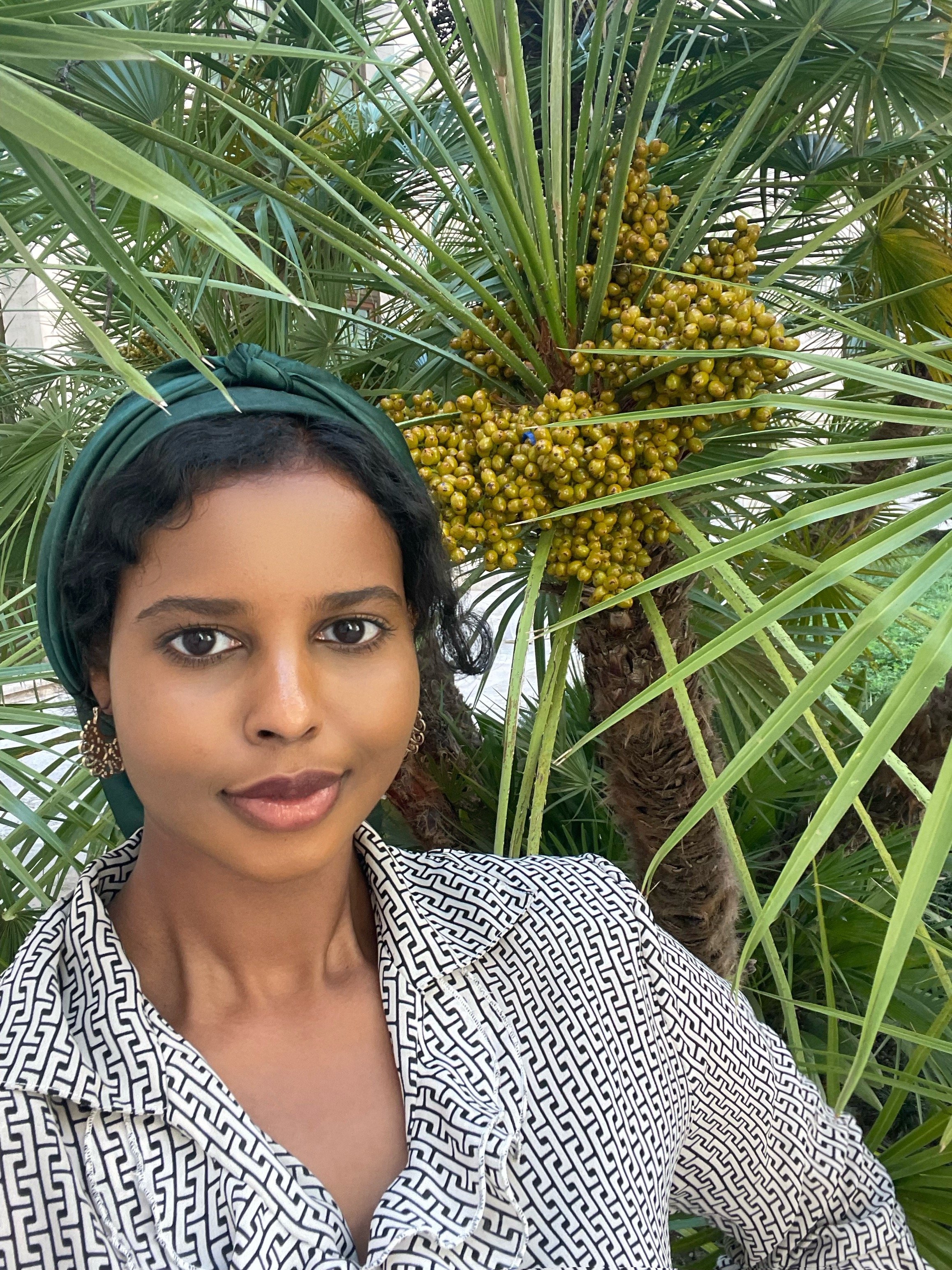
Somewhere in Rome, retracing hooyo's youth. Momtaza Mehri.
“Love is a web of contradictions, and I’ve found that many supposedly pampered children of immigrants have, in their own ways, also sacrificed parts of themselves for the sake of their elders and families.”
This month’s theme is an exploration into love and all of its forms. What are your current musings on love? How has it evolved over the years?
Love is a splinter in your consciousness. I think of it as a truth that can’t be denied, an unavoidable epiphany. It drives you towards action, or away from stagnation. There are people I’ve loved for the clarity they’ve brought into my life. Through loving them, I’ve learned who I am and what I’m willing to fight for. In this mirror, I see my flaws, knowing I can still be forgiven. For me, love has always been a shared practice of integrity. If I love you, I want you to give it to me straight.
Honesty isn’t really a hallmark of our current era, but I still cling to it as a pillar of love.
In Sufficiently Memorable Password Recovery Questions for the Refugee Parent, you move between bureaucratic prompts and intimate reckonings, from memory and loss to questions like “Define love as something other than duty” and “When will you stop holding your breath?” The poem seems to speak to the inherited pressure many children of migrants carry, the sense that we must make our parents’ sacrifices mean something. How do you think about love, obligation, and worthiness in that intergenerational context?
For a long time, I thought of love as intimately tied to obligation. I was firmly attached to that idea and took a kind of perverse pleasure in suffering for love. Sacrifice became a rite of passage, something I had to pay forward, even at the cost of my own sanity. It didn’t bring me peace, and I came to realise how often we pride ourselves on self-neglect. Love is a web of contradictions, and I’ve found that many supposedly pampered children of immigrants have, in their own ways, also sacrificed parts of themselves for the sake of their elders and families. Like those before me, my story of sacrifice is also profound and thorny. We need to see ourselves as part of the same story, not just as witnesses to a past that holds us hostage.
In Bad Diaspora Poems, you often resist both the romanticization of the diasporic homeland and the sentimental framing of immigrant life in the country of residence, without flattening the very real grief, anger, or longing that comes with displacement. How do you approach writing about home and belonging in a way that stays honest and unflinching, without slipping into either nostalgia or cynicism?
You have to feel these feelings, the pangs of grief and need and desire, while not letting them define you. I’m far too comfortable with impermanence, and I know that’s a symptom of generational displacement. But I might feel differently tomorrow. Changing my mind shouldn’t be a catastrophe. Belonging isn’t a destination you can reach. If you view it that way, it can become a dead end. That can stunt the imagination. Being a writer has made me fiercely protective of my imagination, and in many ways, that’s the purest home there is.
It’s possible to be settled, to have roots in a place, and still feel chronically alienated. We live in alienating times, and it’s harder than ever to stay connected to our bodies, environments, and shared realities. The diasporic condition is an amplified version of an increasingly common experience.
What are some works by other writers, artists, filmmakers, or musicians you’ve been returning to lately that feel important to diasporic creative culture right now?
Call me a broken record, but everyone should be reading Bhanu Kapil. I enjoy everything published by Barakunan, an independent press based in Berlin and Beirut. Across film and visual art, Lemohang Jeremiah Mosese has been cooking with gas for a while now. Have also been revisiting Burqa Boyz's 2012 debut mixtape, Miami Arab Emirates, which still sounds delightfully nutty. We need reminders that today’s heated debates were yesterday’s impassioned columns, that we’re just as daring and corny and worthy as our predecessors. Old magazines are engines of perspective. Dig into local archives, libraries, and online marketplaces to find them. I’ve been dipping into Black British and Asian magazines from the 1990s, such as Pride, TOUCH, and 2nd Generation. I love 2nd Generation's tagline: clean living under difficult circumstances.
Momtaza Mehri is a writer and researcher working across poetry, criticism, education, and radio. She was the former Young People’s Poet Laureate for London. Her debut poetry collection, Bad Diaspora Poems, won the 2023 Forward Prize for Best First Collection, as well as an Eric Gregory Prize, Somerset Maugham Award, and a Sky Arts Award.
To Learn more about MOMTAZA MEHRI, VISIT HER WEBSITE & FOLLOW HER ON INSTAGRAM.
COVER IMAGE BY MOMTAZA MEHRI: 1990s Kilburn. The more things change.
FOR MORE RECS LIKE THIS ONE, CHECK OUT THE REST OF VOL. 004:
