
HAVE YOU EATEN?
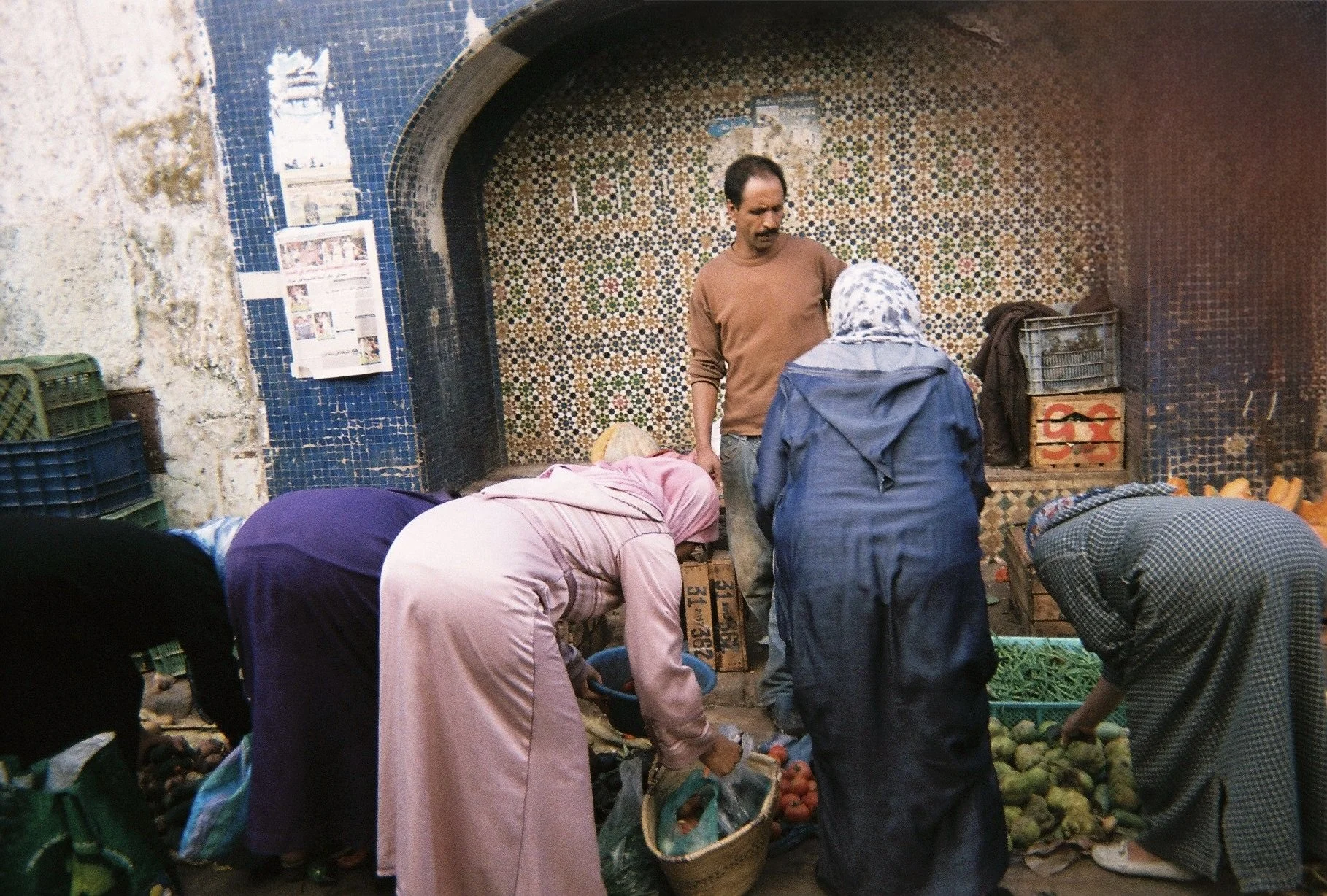
Isha Mazumdar, Mothers at the Market, 2017, Rabat, Morocco.
We all know the five famous love languages (if not, see here). But there’s another that belongs on the list: food. From cut fruit to favorite dishes, this essay, entitled “HAVE YOU EATEN?” traces what it really means in immigrant families.
In many immigrant homes, love does not take the form of a clear sentence.
It comes as a subtle question that looks practical on the surface and, somehow, holds everything underneath it: Have you eaten yet? What did you eat today? Are you hungry? Do you want me to make you something?
You can hear it across languages and kitchens, from the laughing auntie who presses more food onto your plate to the serious parent who calls and opens with logistics instead of tenderness. If you grew up inside it, you learn early that these are not neutral questions. They are feelings in disguise. They are worry made useful. They are a way of saying I’m here, even when “I love you” might feel too exposed, too unfamiliar, or simply not the way love was taught. [1, 2]
Take, for example, in many Asian families, the translation of a plate of cut fruit is almost a cliché because it’s so real: “Have you eaten?” doesn’t only mean food. It means How are you holding up? Are you safe? Are you okay out there? Writers and psychologists have pointed out how, for many Asian families shaped by high-context communication, care is often expressed indirectly, through acts and attention rather than verbal affirmation. [3]
Research on Chinese American parent–adolescent relationships even captures parents’ care showing up in recurring check-ins like “Have you eaten?” alongside questions about school, a pattern that frames love as monitoring, tending, and responsibility. [4, 5]
So yes, sometimes it is cut fruit. Not because fruit is magical, but because it’s intimate. It’s the extra step. The peeling, the slicing, the arranging is the small labor that turns “there’s food in the house” into “I prepared this for you.” That kind of care can feel almost embarrassing in its sweetness, especially when you’re young and trying to be hard-edged or independent. And then you grow up and realize: someone was making sure you were fed when they didn’t know how to say they missed you. [6, 7]
In another context, in many Latin American and Caribbean families, the same emotional ingredients appear but are served differently. Food is how you get welcomed, comforted, and pulled back toward the center when life scatters you. It’s the container for affection and pride, for “come sit,” for “tell me everything,” for “don’t worry, you’re home now.” Even when the words are sharp and everyone is tired, a plate still appears, as its own kind of apology. [8]
Anthropologists have a word for the social power of eating together: commensality. It’s the idea that sharing food builds and reinforces bonds, that a table is not just where we refuel, but where we become a we. [9] That matters even more in immigrant life, where so much can be unstable. When language shifts, belonging is contested, or a parent’s work hours swallow the day, food often remains the most dependable form of closeness. It’s a daily, repeatable way to say: we still have each other.
This is why the “food questions” land differently. When an immigrant parent asks what you ate, they’re often asking more than that. They’re asking if you’re taking care of yourself in a world that may not take care of you. They’re asking if you’re lonely without saying the word lonely. They’re asking if you’re working too hard, sleeping too little, forgetting your body. They’re reaching for you with the tools they trust: nourishment, provision, insistence.
For the kids on the receiving end, that insistence can feel like many things before it feels like love. At first, irritating, repetitive, or even controlling. It’s another question when you just want space, another plate when you've said you're full. But meaning shifts over time, and eventually those questions reveal themselves as something else entirely: the steadiest form of devotion you've known. Love that shows up whether or not you feel you deserve it. Love that doesn't wait for the right moment or the perfect words. In many immigrant cultures, this is the real translation as love is demonstrated rather than declared. It’s carried from hand to hand, wrapped, packed, sent home, reheated, and offered again. It may not be grand or poetic, but it is functional and persistent. ”Have you eaten?” is the banal YET ALL THE MORE BELOVED question that waits for your answer; it is a love note in its purest form.
FOR MORE RECS LIKE THIS ONE, CHECK OUT THE REST OF VOL. 004:
