
LOVE ACCORDING TO THE STARS WITH ALICE SPARKLY KAT
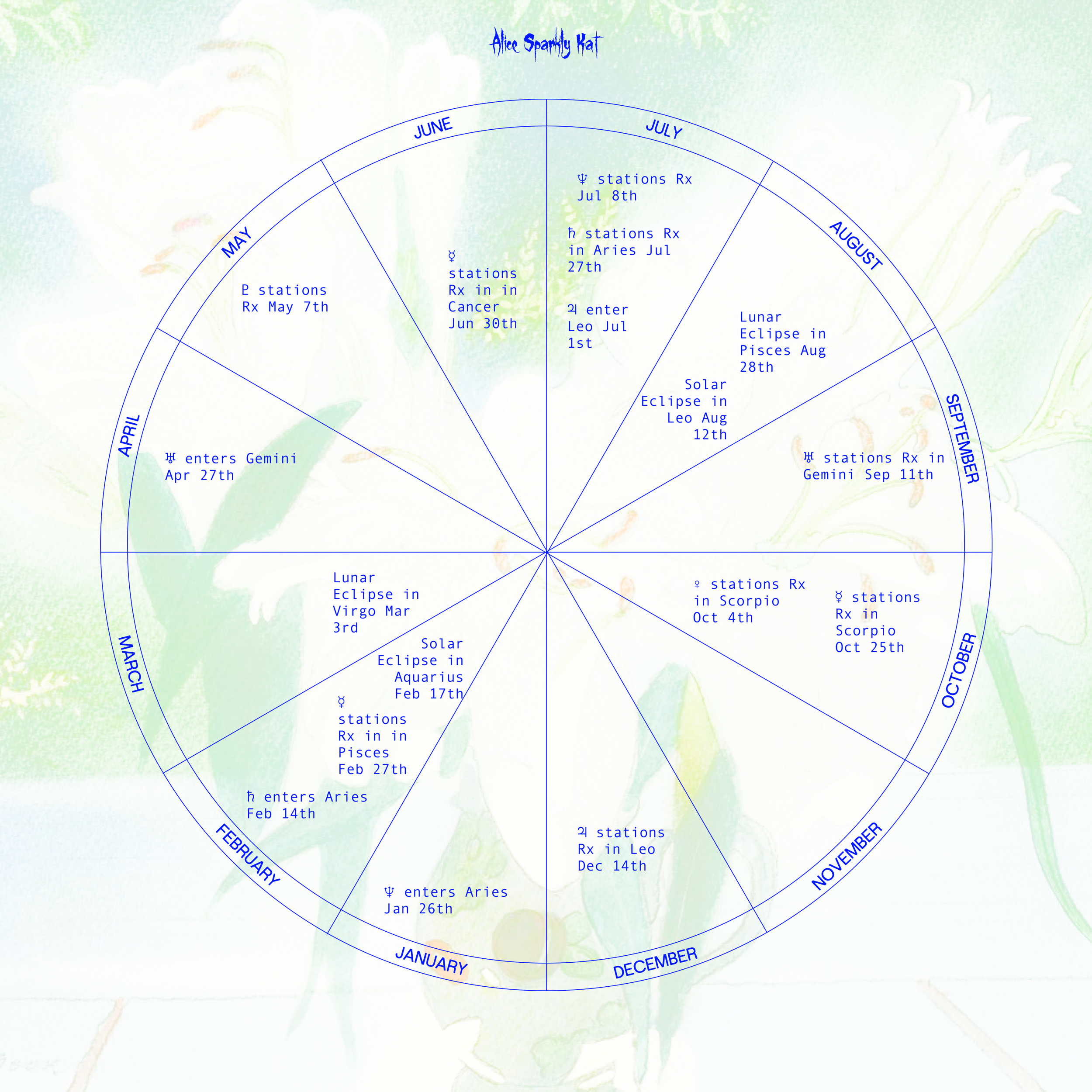
2026 AT A GLANCE BY ALICE SPARKLY KAT.
Ace, the astrologer behind Alice Sparkly Kat and the author of Post-Colonial Astrology, practices both horoscopic astrology and bazi (Chinese eight-character fortune analysis). Their work does not just map stars. It maps power, time, and the relationships that shape us.
In our conversation with Ace, we asked about practicing the two different systems, astrology as a political form, and, of course, love.
Your work encompasses post-colonial astrology as well as Chinese-style fortune-telling. Are there other divinations you practice or are currently learning? How does one inform the other? Do you find tensions or harmonies between these different systems?
I stick to horoscopic astrology and bazi (Chinese eight-character fortune analysis)! Both are quite complicated, so it takes a lot of time to learn one astrological language. I’m in my tenth year of practice in horoscopic astrology and am much newer to bazi.
I think that starting with horoscopic astrology has been really helpful for me because there’s such a vibrant queer subculture around the practice. The way that queer people interact with spirituality is a lot more participatory and playful than Religion with a capital R. Bazi, maybe because it’s exoticized, has a lot more of a weird New Agey, hippie stuff around it here in America but my experience as a queer astrologer working in the horoscopic tradition (Aries through Pisces) has taught me that spirituality needs to be imaginative and collaborative. It’s a language, not a doctrine.
Since bazi is Asian, I find that there’s a general tendency to silo it or isolate it, which is part of the exoticism factor. Because I am Asian American and diaspora, I refuse to engage with bazi in that way. I think that it’s important to practice spirituality syncretically because we are all making our place in this world alongside many different cultures, and the history of Chinese spirituality and Chinese people in this country have not been in isolation but in collaboration. I’ve been doing these workshops, kind of based on the wuxing, with a friend who brings in their own practice with Kongo spirituality for a few years. Entering Horse year in the US, I’ve been trying to learn more about horses in American history (cowboys, Spanish, Pueblo, Lakota, etc.) because that’s so much more relevant to the Asian American experience than horses in some ancient era in China.
There are also things about my relationship with bazi that have changed my practice as a horoscopic astrologer. I didn’t learn about yin-yang theory or the wuxing from friends but originally from my family. So, I don’t really explore the online world around it as much, and I like that. I think that when a spiritual practice gets commodified, people start to think of the medicine as a balm or a product that they can buy, but real medicine is orientation. You have to figure out how to circulate clean water in your environment by honoring graves and the rivers—that’s the first principle of medicine, and you can’t really buy that in a store.
Astrology is a longstanding ancient practice. How do you reconcile honoring ancient astrological traditions (if at all) while practicing post-colonial astrology in present times? What does decolonizing this practice look like in your day-to-day work?
I don’t think of decolonial work as honoring what is ancient. Decolonial creativity is contemporary because it’s happening in the present, and the work is making another future possible. I’m actually sort of wary of the idea that astrology is valid because it’s an ancient practice. Sure, but it’s also a contemporary practice. Shamans didn’t just die off a hundred years ago. The practice is still around. It’s still being done by marginalized people, queer people, but there’s a tendency to be more willing to honor the legacy of the past than to look at the present.
In my day-to-day life, I work with people. I do readings, and I am an astrologer who still sees that as the bulk of my practice. I don’t have a therapist background, but I was an arts educator for several years, so a lot of what I do with people is to try and find a creative way of living, not just making art like a product. I also do workshops with a consistently meeting group, which are kind of like community rituals with activities. My main purpose in all my work is to support people in feeling alive. My main purpose in my astrological work, because astrology deals with narrating time, is to support people in making more time for each other (supporting patience, ritual, consistency). I also write, but that’s more for my own pleasure. I guess reading/writing is also a way of making time.
The theme of this issue is love and all of its forms. What have you learned about love through your practice? And how do you see astrology as a tool for understanding love’s complexities?
Whew! What a question. I love it, and I’ll respond to it in two ways using horoscopic astrology and bazi.
In bazi, love is thought of as being held by the heart, which shares nature with fire. Just like fire, which doesn’t weigh anything, the heart is originally empty. It can hold both love and hate, both kindness and cruelty, but it must be hollow so that everything that is held can move through. That’s like fire. Fire can be destructive, but a wildfire also promotes growth because it returns nutrients back to the soil. Fire doesn’t just exist like an object. It is constantly burning and moving. So, in this framework, love (and hate) both have to be moving like an action or else it will not exist. Love is a movement, not a thing that you can hold, but something that you do.
In horoscopic astrology, Venus is sometimes thought of as the planet of love. I actually prefer to think of Venus as the planet of choices because it’s the planet that has to pay a toll when it reaches the crossroads to the spirit world. Venus, the planet of choosing people and being chosen. I think of morning star Venus as the planet of ethics and evening star Venus as the planet of desire. Your ethics teach you about trust, and your desires teach you about pleasure. Both can be a struggle because both have us dealing with questions about what is right or wrong, or right for ourselves. Venus, being the planet of love, is also the planet of grief because you don’t stop loving people after they die.
When I do readings with people, I kind of try to see what framework they’re already thinking of love in and try to listen for that and engage like a play partner. Sometimes, if I feel like the session needs more energy, I try to tell a myth or grab something from a system to invigorate the conversation. But people know what love is, so I try to stick to listening and using astrology, whether that’s love in the heart or love at the crossroads of choice, as a reflective tool.
You talk about how astrology exists as a political form. In what ways do you see astrology functioning as a political practice? What political work can astrology offer that other frameworks might miss?
It’s funny that you ask this question because there’s been a whole social media debate among astrologers about whether astrology should be political recently. I’m in the camp that says that astrology is inherently political.
Your natal chart isn’t just about you, and it isn’t static either, because the sky isn’t static. You have your family in there, your friends, your relationship to land, to pets, to enemies, and all these relationships. You have all these changes you go through, which come to you through your relationships. No one is able to just sit in a room and mature or transform in isolation.
Politics isn’t about some astrologer’s opinion. Politics is the analysis of power, and power exists as long as you have any relationships at all. So, I believe that an astrologer who doesn’t analyze power with you isn’t doing an honest job of reading your chart. Some astrologers are very against astrology being political, but my question would be—what is it then? Is astrology just an aesthetic? I don’t think that’s very useful.
You often end your monthly horoscopes with a list of questions for each sign. Do you have a guiding question for your own life that you find yourself returning to and/or a fundamental question you think is important for our audience to ask themselves during this moment in time?
My mind is blank on a fundamental question for our moment in time right now. I include three questions for each horoscope because I know many readers also practice tarot, so the questions are actually there for people who like to pull a card for each.
A guiding question for my own life right now is the question of coherence. Maybe someone out there will relate to this. I feel like I lack a lot of coherence in my life because I had to move so much due to reasons out of my control. I’m trying to create a self in each place I adapt to, but I’m looking for not a core sense of self but a coherent story of why I am here in this place. Maybe that question of coherence is also how I’m thinking about our political moment: Where are we in time, and how did we get here?
Lastly, is there a recommendation you can pass on to our readers (ideally something connected to diasporic communities)? It could be a book, a song, a film, a place, a meal, an artwork, or even someone to follow.
What a sweet question! I’d like to recommend two books:
First, I’d like to recommend Mounted: On Horses, Blackness, and Liberation by Bitter Kalli for 2026 Year of the Horse. I loved this book about horses because I think that Bitter Kalli really writes about horses and the people who have worked with them in a caring way. That’s rare. I also think that the themes discussed in the book, about horses and work or horses and power, are so relevant to thinking about Horse year in 2026. This isn’t an astrological book, but I think that reading about horse history and people’s relationships with horses is much more interesting than trying to engage with horses as an abstract symbol.
The second book is one I recommend to anyone who wants to think about Neptune moving into Aries this year: Smoke and Ashes by Amitav Ghosh. This book is about the global opium trade in the 1800s, about how that trade impacted not just Mumbai and Kolkata but also Bihar. The book also refuses the western way of thinking about history as a sequence of competitive ideas, which creates these mental blocks and walls between us. Ghosh advocates for this way of listening to material objects speak that is very profound and much deeper than our usual way of understanding history, and he offers a rich study of not just the opium product but also the poppy plant as a plant that creates its own history. In 2026, Neptune moves out of Pisces and into Aries. A lot of people are talking about the American Civil War taking place on the last Neptune in Aries, but planets transiting into signs don’t just make random events happen. People (human and non-human) make history cyclically because we reference our histories. I think that it’s important to keep in mind that the period of Neptune in Pisces in the 1800s was the rise of the global opium trade and that 2012, when it entered Pisces last, was the peak of the opioid crisis. Neptune in Aries comes after Neptune in Pisces for a reason.
Alice Sparkly Kat (ACE) is an asian-american astrologer and author of Post-Colonial Astrology. They practice both horoscopic astrology and bazi, bringing a relational, political, and imaginative approach.
CATCH ALICE SPARKLY KAT’S UPCOMING WORKSHOP WITH FORTUNE PRESENTS: YEAR OF THE FIRE HORSE x RAMADAN IN PHILADELPHIA ON FEBRUARY 21st.
To Learn more about ALICE Sparkly Kat, VISIT THEIR WEBSITE & FOLLOW THEM ON INSTAGRAM.
FOR MORE RECS LIKE THIS ONE, CHECK OUT THE REST OF VOL. 004:
